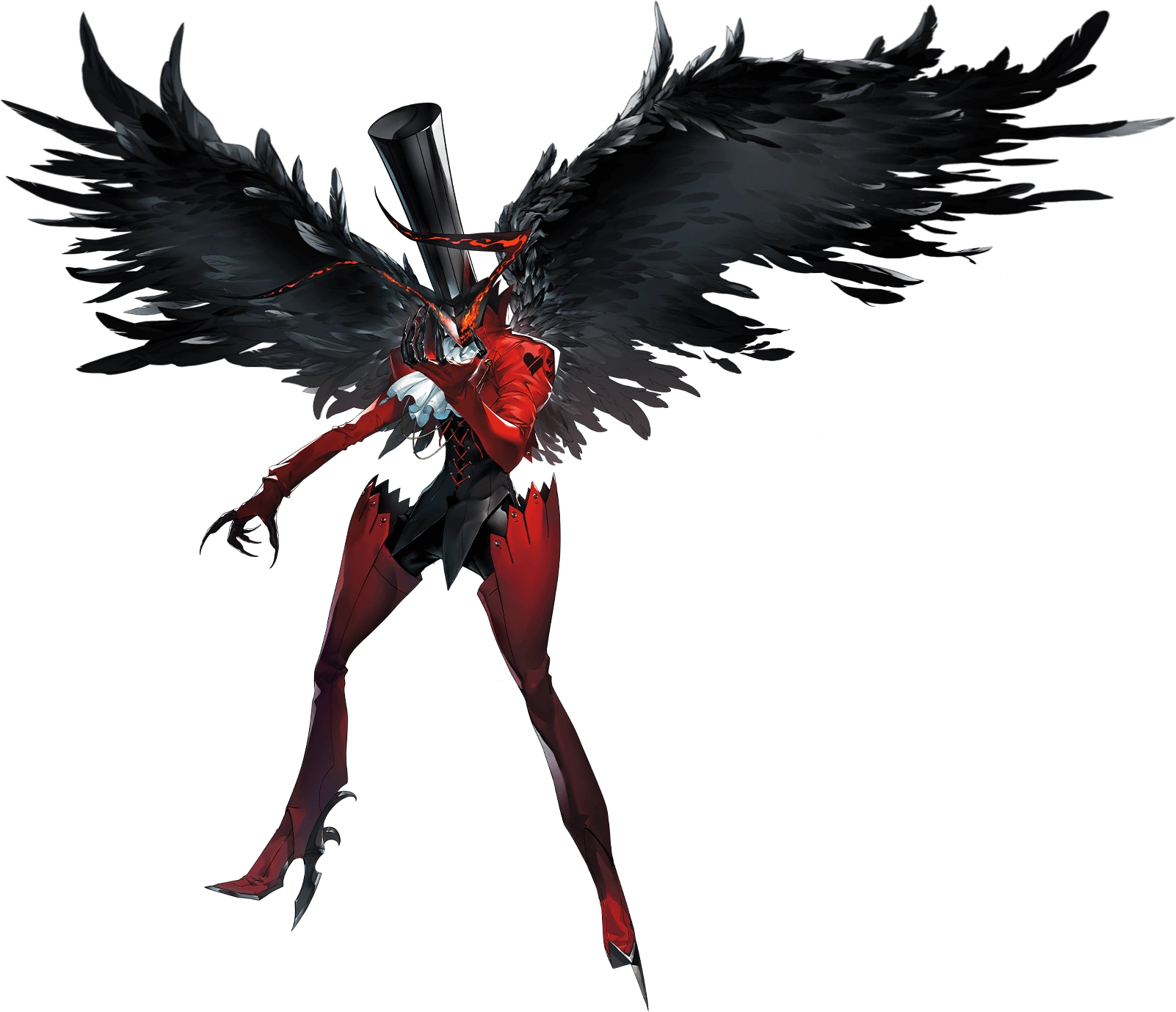
Arsene
Arsène Lupin, sometimes known as Raoul, is a fictional gentleman thief created by Maurice Leblanc. He was known for targeting criminals or those who were much worse than himself, making him an anti-hero of sorts within his own stories. He might have been partly inspired by the French anarchist Marius Jacob
Arsène has, from top to bottom: a very tall top hat, a long-horned mask for its face (as Arsène appears to not have a head), a cropped red eighteenth century-esque suit worn open with the collar popped, stitched heart designs on the shoulders, a white ruffle tie, a black, tailed corset running down its torso; large, black, feathery wings starting at around the small of its back; claws; red coverings on its legs resembling pants and boots with blade-like heels.

Zorro
Zorro (Spanish for "fox" and "sly") is a fictional character created in 1919 by New York–based pulp writer Johnston McCulley. His true name is Don Diego de la Vega. Zorro is a Californio nobleman of Spanish and Native Californian descent, living in Los Angeles during the era of Mexican rule. He is a masked outlaw who defends commoners and the indigenous people of the land against tyrannical officials and other villains, riding atop his steed Tornado.

Captain Kidd
William Kidd was a Scottish pirate and privateer in the 17th century. His early career was spent in the Caribbean, where he aided the besieged English colony of Nevis by ransacking the attacking French. In recognition of his actions, the King of England awarded him a letter of marque, granting him legal protection so long as he remained loyal. However, during a voyage to the Indian Ocean, his crew plundered a neutral ship without his knowledge, branding him an outlaw once more. Eventually, he was captured and sent to London, where he was tried and executed.

Carmen
Whatever the version, Carmen is generally depicted as a classic femme fatale who would take advantage of her beauty and charm to make men fall for her, but quickly break the relationship once she is bored of her wooer, and then she looks for her next victim.
Carmen appears as very tall woman with fuchsia colored skin. She wears a long flowing red ballgown, black gloves, and black-red boots. The dress is mostly light red with alternating black and gold trim along its many layers. The dress has a black corset with red heart designs and shows a generous amount of cleavage. Her gloves and boots share the same color and heart designs as the corset. Several roses are seen growing out of the base of the corse.Carmen is typically seen with two figures that seem to be men in tuxedoes and red bow-ties, but their heads are metallic pink boxes, with glowing heart designs for eyes and speakers for mouths. The figures are physically attached to Carmen via a pair of thorny vines that connect to the roses..
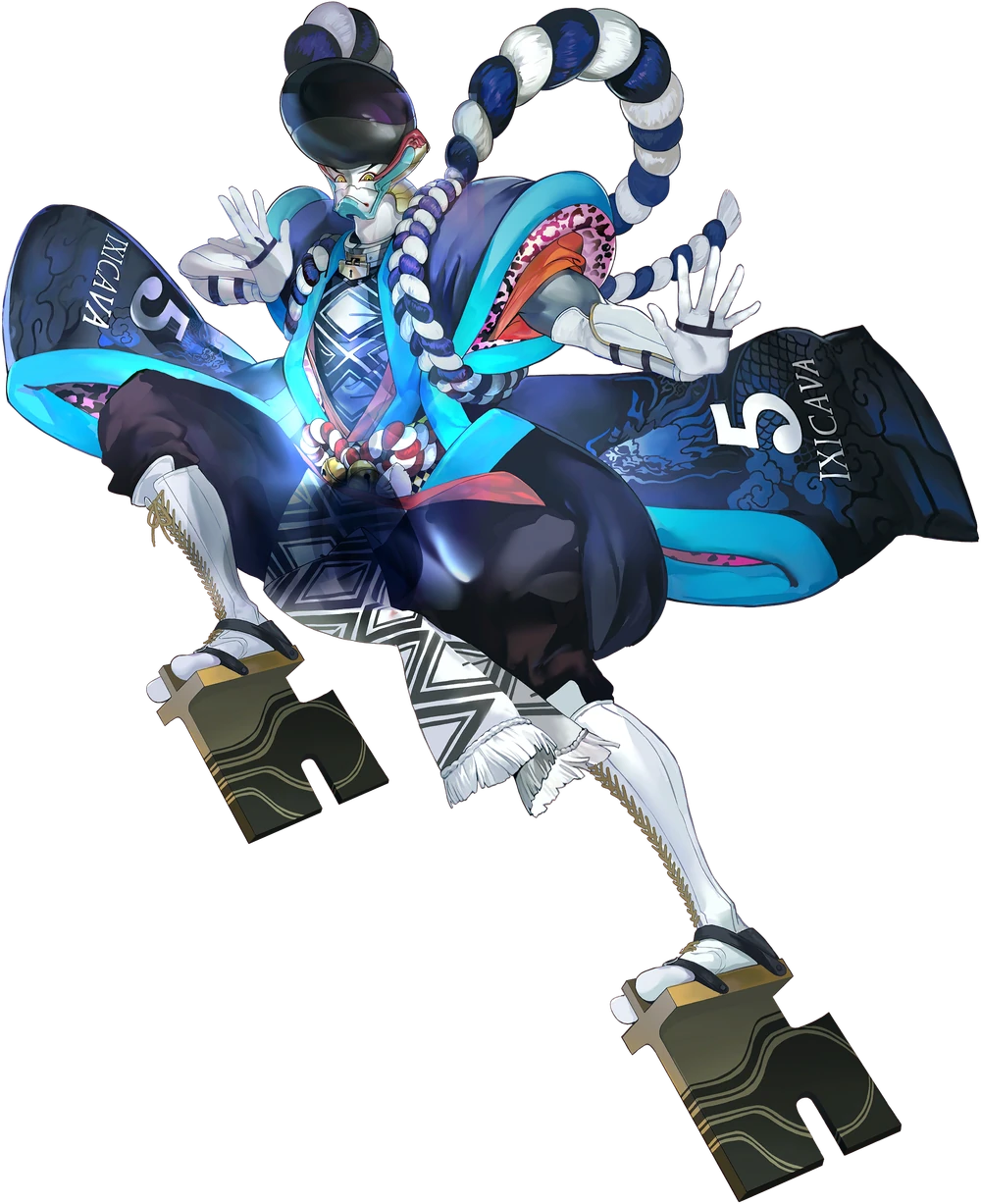
Goemon
Ishikawa Goemon was a Japanese outlaw, and his birth name was Gorokichi. The historical Gorokichi is only mentioned in two sources, both of which were created after his death. The first one, the Toyotomi Hideyoshi fu details his attempted assassination of the shogun Hideyoshi Toyotomi, his capture, and his execution alongside his young son in 1594. Goemon's death by being boiled alive was also described in a second historical source by Pedro de Morejon who transcribed his name as "Ixicava Goyemon".
Goemon has a white face and white puppet-like arms and hands in the style of Kabuki, a turquoise beard that extends up to a yellow and red holder that looks like part of his hair, and a black, afro-like, pompadour-style chonmage. He wears dark blue uchikake haori with light blue accents and pink panther lining underneath, large dark blue and white shimenawa rope flared around the shoulders, and a gold obi sash held by red and white shimenawa rope.
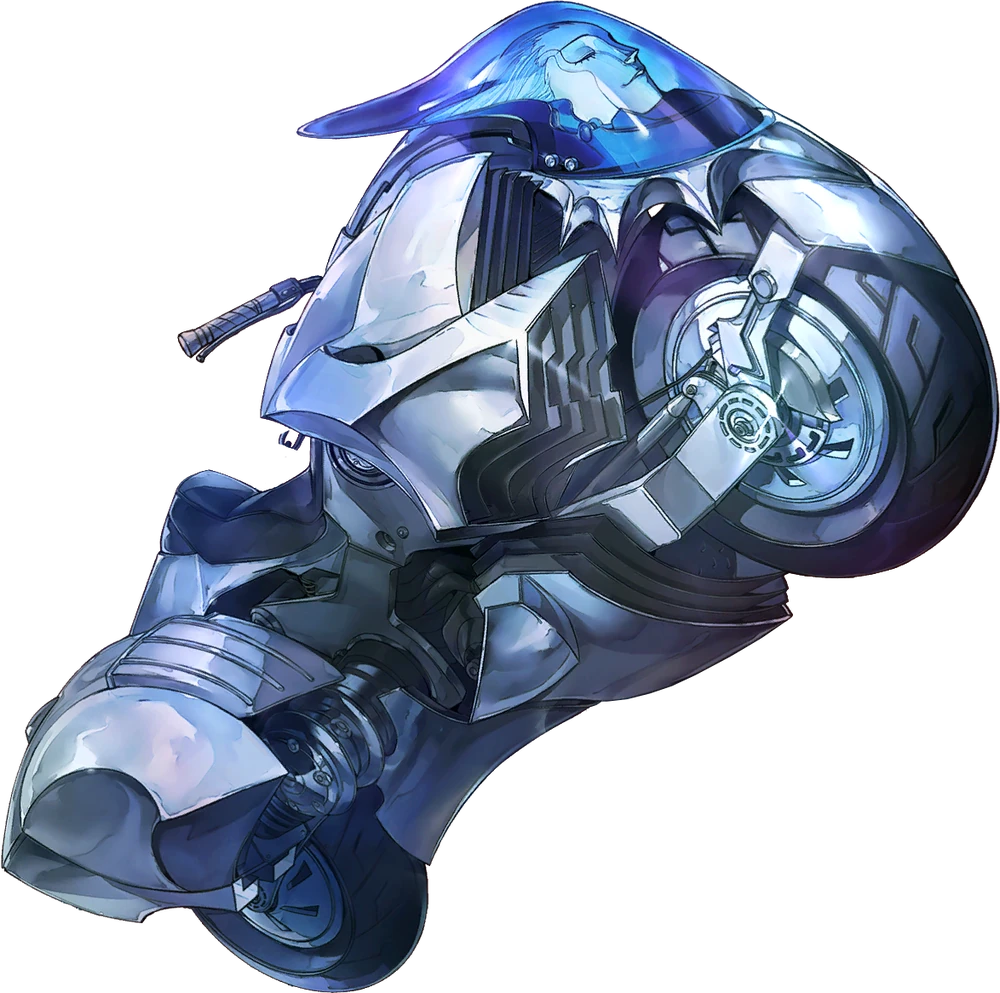
Johana
Johana was a mysterious female pope of the middle ages. She posed as a man eventually made it all the way upto the pope due to her unrivaled intellect. Her existence shook thhe history of Catholic churche's. The story was widely believed for centuries but modern historians have found no evidence of her existence and believe the legend to be a work of fiction meant to discredit the church.
The main body is a large, gray motorcycle, but it’s not a normal one it’s bulkier, almost tank like, with heavy metal plating and sharp, angular parts. The front of the bike has a kind of armored faceplate, giving it a slightly intimidating, almost “helmeted” look instead of something sleek or sporty
Built into the motorcycle is a humanoid upper body, like a rider fused directly into the machine rather than sitting on it. This figure looks very rigid and armored, almost like a medieval knight or a mechanical enforcer.

Necronomicon
The Necronomicon, whose original name is Al Azif, is a fictional grimoire, or tome of magic. It was first mentioned in the short story The Hound written by H. P. Lovecraft, but its exact origin is the subject of debate. The book subsequently also appeared in stories of Lovecraft's followers. The Necronomicon has since gained a cult following and various fake "replicas" of the book are circulating.
Rather than a book, the Necronomicon resembles the classic depiction of an alien UFO, with a circular spinning design and green/blue designs across the hull. The lower side of the ship has glowing blue lines across the inner space, as well as 5 glowing orbs of energy that shine light downwards. The top part of the ship is green and has numerous designs that vaguely resemble scientific, mathematical, anatomical and mythological symbols. Atop the ship, there appears to be a stone gargoyle in a crouching position and very small wings.
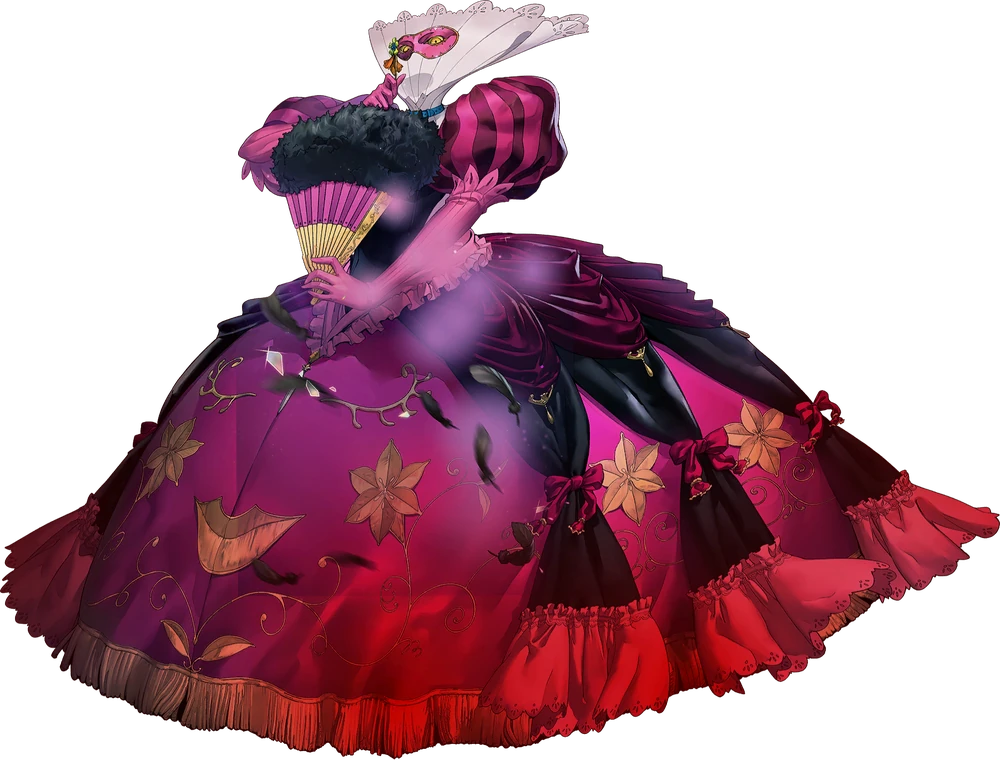
Milady
Milady de Winter, more commonly referred to as "Milady" is a fictional character created by Alexandre Dumas for his seminal novel The Three Musketeers. Her main relation with the novel's titular heroes is her personal vendettas first against the novel's hero d'Artagnan after he discovered she was branded as a criminal with a fleur-de-lis, then against his mentor Athos who was her former husband. Her conflict with them ends in her death by beheading for her crimes.
Milady appears to be wearing a black and pink Rococo style dress, with red and pink vertical striped puffs on the sleeves of the dress that extends to her elbows and wearing pink gloves. The bottom of the dress is in a pink color with golden trim around the dress, which has a golden lip on the center of the dress that makes it resemble a smiling face. There are black and red curtain drapes around the dress underneath, a pink heart shaped frill around her waist with a red bow tied on the drapes and a knife next to on the center of the heart shaped frill. When attacking, the dress opens up to reveal an array of ranged weaponry, including two Gatling guns, a bazooka, and a missile.

Robin Hood
Robin Hood is a heroic outlaw in English folklore who, according to legend, was a highly skilled archer and swordsman. Traditionally depicted as being dressed in Lincoln green, he is often portrayed as "robbing from the rich and giving to the poor" alongside his band of Merry Men. Robin Hood became a popular folk figure in the late-medieval period, and continues to be widely represented in literature, films and television. Robin Hood fought against the evil Sheriff of Nottingham who was loyal to Prince John who had stolen the throne from his brother, Richard. Later stories introduced the Guy of Gisbourne, an assassin sent for Robin’s head who eventually became part of a love triangle with Marian.
Robin Hood generally resembles an exaggerated caricature of a superhero, with a large muscular frame and a red-white-blue color scheme with gold trim. His breastplate is colored blue with a gold "RH" logo on it. His shoulders are decorated with red-gold epaulettes and he wears a flowing two-piece cape that is blue on the inside and white on the outside. He wears a red belt with a silver buckle that has a wing-design on it, supporting a black-white skirt and black-white tights that lead into white boots.
Robin Hood's bow is almost as tall as he is and appears to fire golden arrows that appear out of thin air. The bow is gold and has similarly golden feathers flowing down the top and bottom limbs. The grip of the bow has a rounded center with "ROBIN HOOD" engraved around it.
Cendrillion
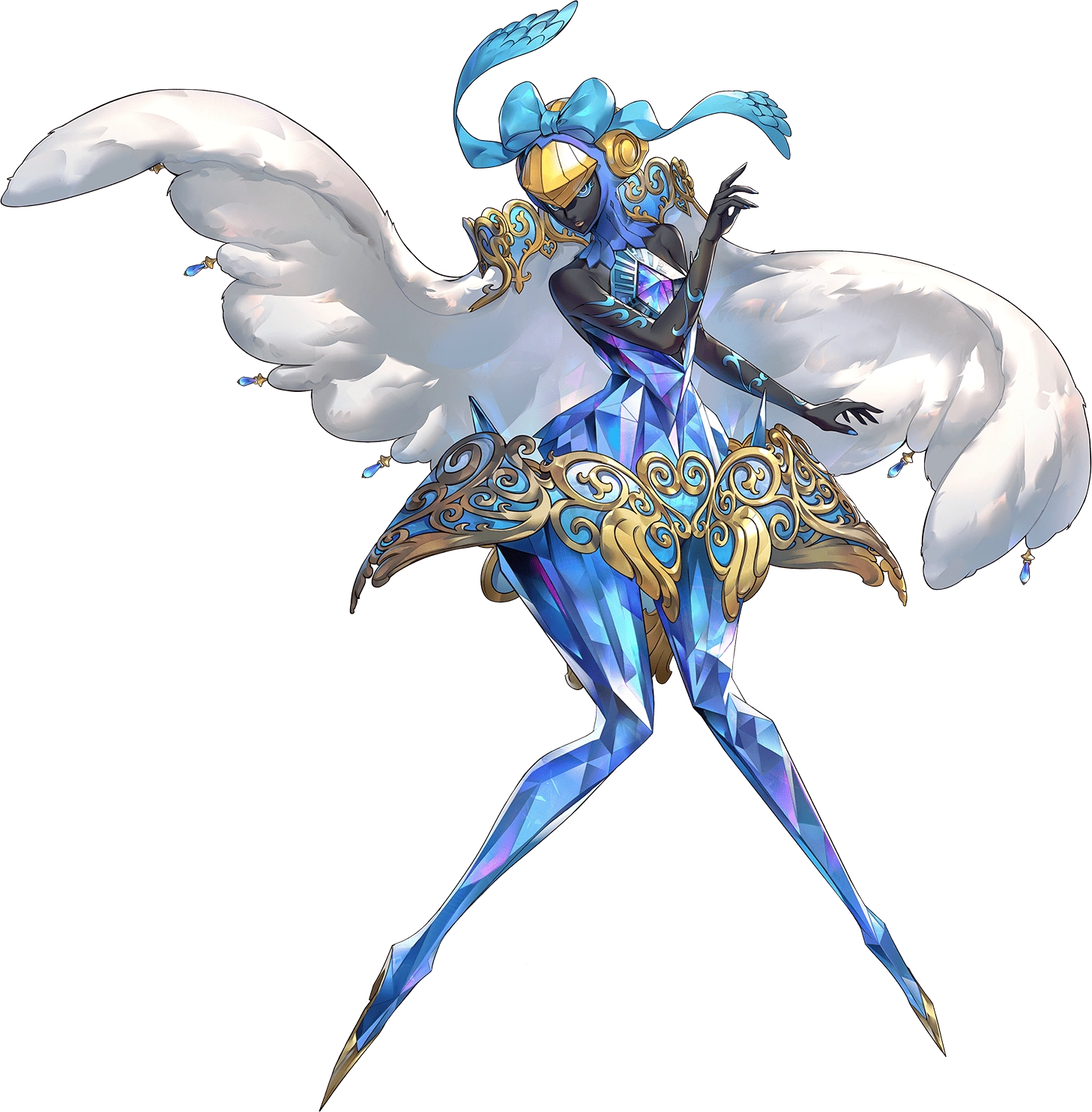
Cendrillon is the French adaptation of the classic folk tale Cinderella. Charles Perrault was one of many authors to adapt the story, which began as a Greek folk tale. His novel became the most famous version, as it was the first to introduce the iconic "glass" slippers, as well as featuring the pumpkin carriage and a fairy-godmother. Perrault's adaptation lead to several operas such as Cendrillon, scripted by Jules Massenet and Henri Caïn.Cendrillon is not her name, but a nickname from her stepfamily as she was often covered in ash (cendre) when sleeping next to a fireplace to keep warm.
Cendrillon appears as a woman with ash-black skin and blue crystalline glass clothing. Her torso is covered by a glass dress, with a teal rhombus/diamond-shaped centerpiece covered in black numbers, with a diamond-shaped jewel in the center. Her waist is surrounded by a floating circle of golden armor with ornate heart and wing designs. Her legs are completely covered by what seems to be a pair of glass thigh-high boots with sharp gold spikes at the end. She has blue eyes and blonde hair, with her hair tied in a light blue ribbon, whose ends seem to float in the air. Cendrillon's white cape flows down to her waist from a set of floating glass hearts that levitate just behind her neck and red lipstick.